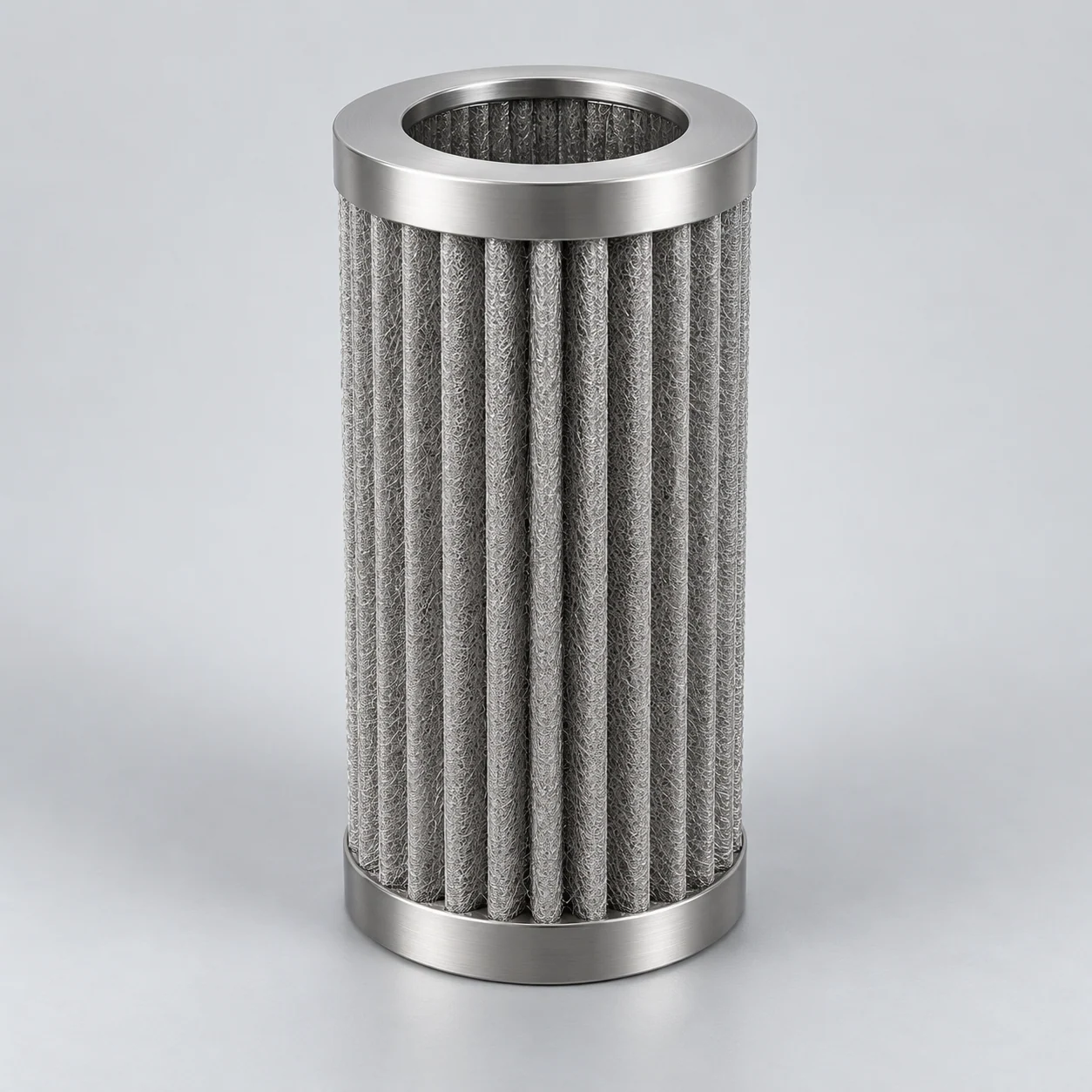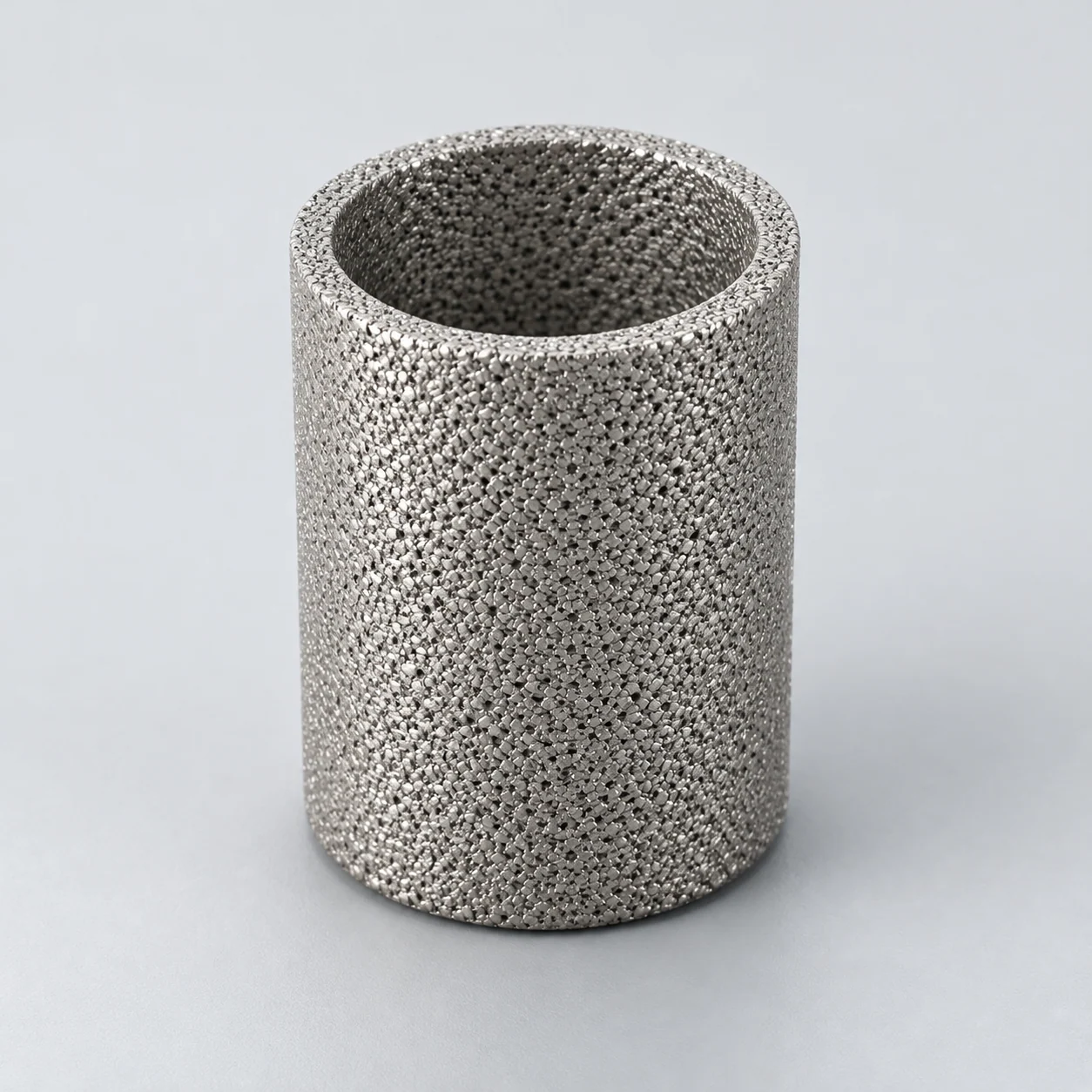
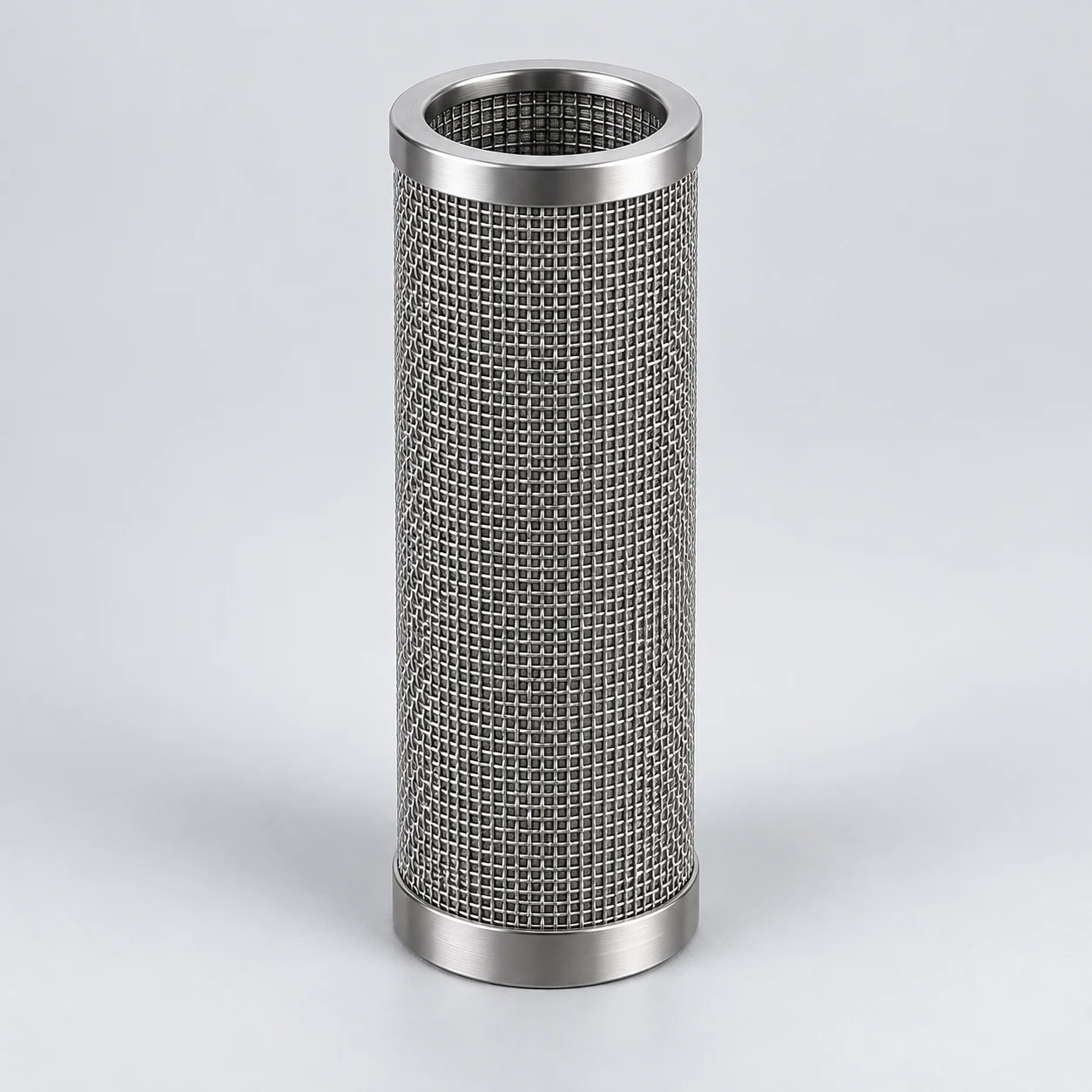


Central cooling/process-water station: multi-candle backwash filter
Element positionIn the selected full-flow or side-stream water circuit, before the protected distribution system or heat-transfer equipment; the plant designer defines pump and isolation positions.
How the element works
Parallel metallic candles provide filtration area within one housing. In the double-open-ended example, water enters the candle interiors and crosses the wall inside-out. Selected-candle backflushing uses reverse flow and an axial sweep to discharge retained solids while the other candles remain in filtration. The cleaning manifold is part of the system, not a property of the mesh alone.
Double-open element bank in a water backwash filter
The main view shows filtration only: feed reaches both open ends of the candles, passes inside-out through the walls and leaves from the surrounding filtrate space. The separate right-hand inset shows a selected candle during backflushing: axial sweep and reverse wall flow carry solids toward its lower drain. The inset is a different phase, not a simultaneous flow path in that candle.

- Feed distribution
The lower dirty chamber supplies the bottom openings and a riser supplies the upper openings. The drawing simplifies the distributor.
- Double-open candles
During filtration, water travels from the bores through the metal walls into the surrounding clean chamber. Both ends are open.
- Filtrate outlet
The clean surrounding chamber collects the filtered water and supplies the outlet.
- Selected backflush phase
In the separate inset, a control arrangement restricts the top and connects the lower bore to discharge; axial sweep and outside-in flow assist removal. Exact controls are equipment-specific.
- Solids discharge
The selected bore discharges the dirt-laden wash stream through a controlled route. This is not an uncontrolled bypass from the normal dirty chamber.
Typical operating conditions
- Record seasonal water quality, suspended particles, fibers and any biological fouling separately.
- State full-flow versus side-stream application, peak liquid flow and available pressure at the filter inlet.
- Include backflush water availability, drain backpressure and the receiving route for solids.
Selection decisions
- Retention objective
- Start with the protected equipment's tolerance. Screen aperture and a tested particle-removal rating are different specifications.
- Construction and cleaning
- Check openings, supports, seals and the flushing selector. A proposed sintered-mesh design needs compatibility review against the original woven-mesh or wedge-wire construction.
- Area and pressure budget
- Size effective area from liquid trials and loading. Separate housing pressure, clean/dirty operating loss and forward/reverse element differential-pressure limits.
Verification and application limits
What to verify
Agree retention, pressure-drop recovery and solids-discharge checks over representative dirty-water cycles, including the downstream flow during cleaning.
Application limits
Particle screening does not remove dissolved salts or establish microbiological control. OEM interchangeability and the economic choice of metal medium are confirmed for each project.