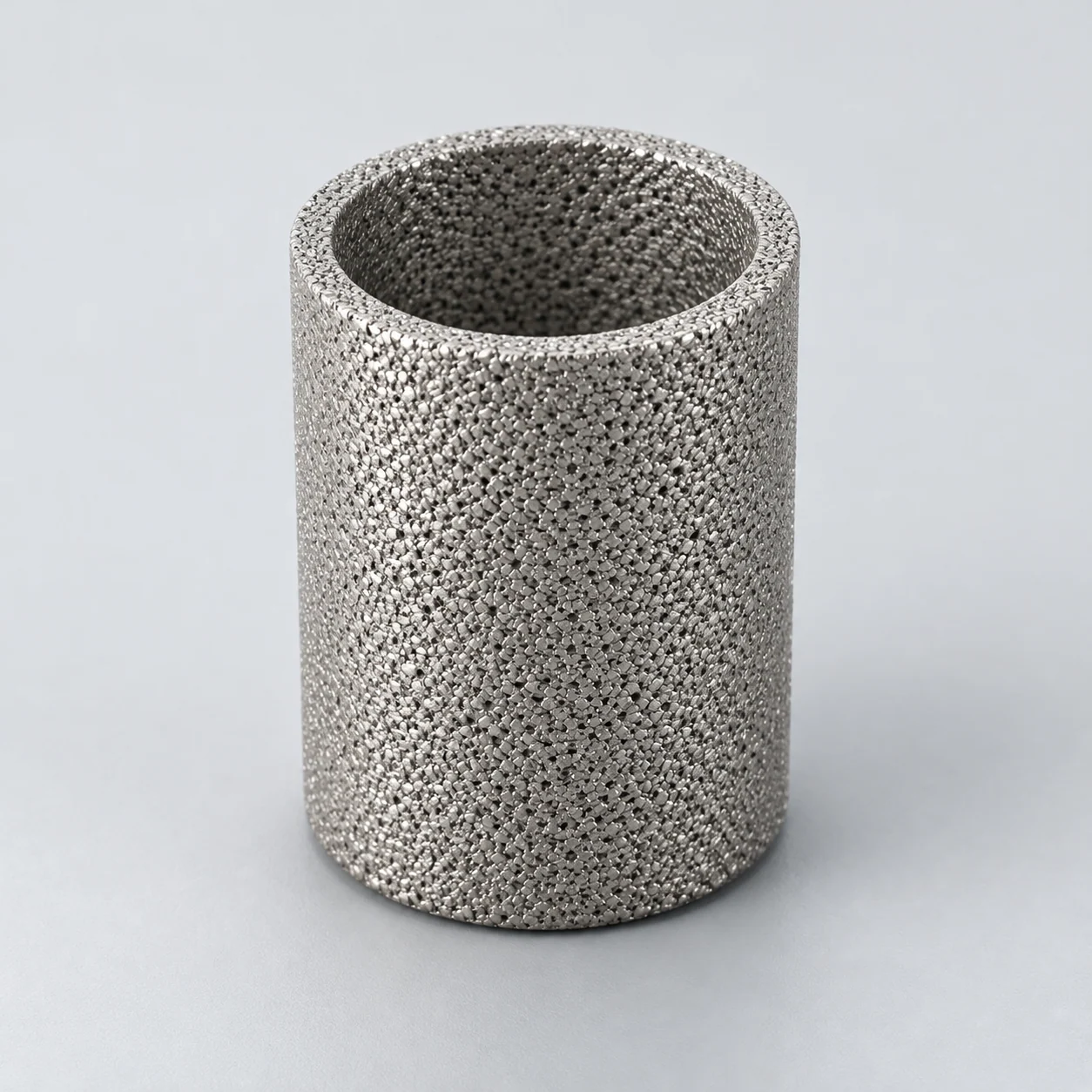
Application selection guidance. Supply grades, dimensions and performance are confirmed against the proposed element, reviewed evidence and written technical requirements.
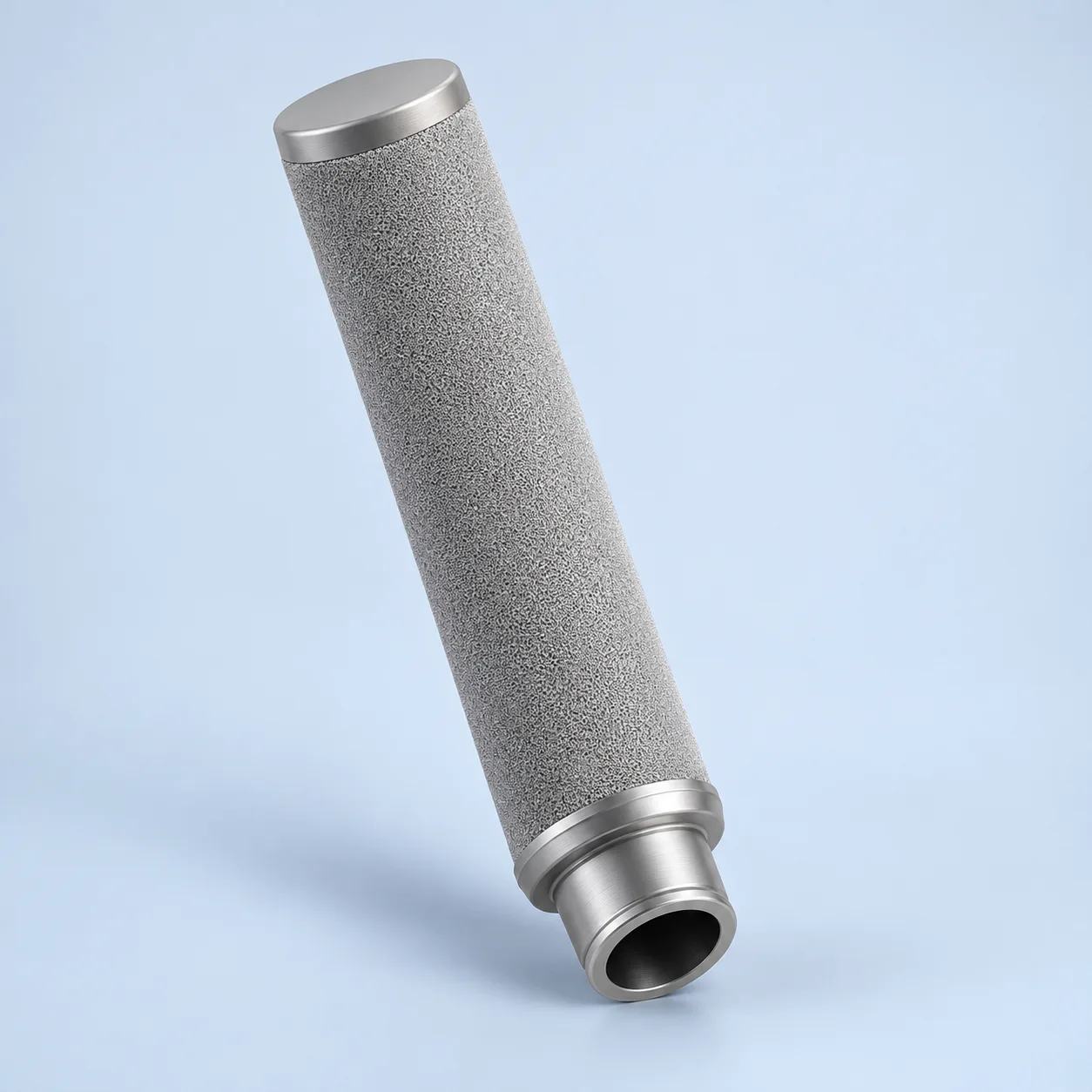
Porous titanium candle — wall and central passage

Porous titanium candle — wall and central passage. Numbered connections, filtering medium, clean passage and closure are identified.
- Lower clean-side connection
The open lower passage connects to the housing filtrate collector; seating and seals follow the approved drawing.
- Porous metal wall
Interconnected pores provide a flow path through the wall.
- Liquid-filtrate passage
Liquid crosses the outside-in porous titanium wall and leaves downward through the open lower connection.
- Closed upper end
The upper closure prevents suspension from entering the clean passage without crossing the porous wall.
Liquid-clarification candle housing
One selected equipment arrangement is shown to explain position and flow. Verify actual flow, connections, seals and operating sequence against the equipment drawing.

- Porous titanium candles
Candle positions within the clarification housing shown.
- Feed-side annulus
Suspension reaches the outer surfaces; retained solids stay on the feed side.
- Clean-side collector
Filtrate crosses the porous walls and drains through the central passages.
- Housing feed connection
The inlet shown is one arrangement; confirm the housing drawing and flow direction.
Product images
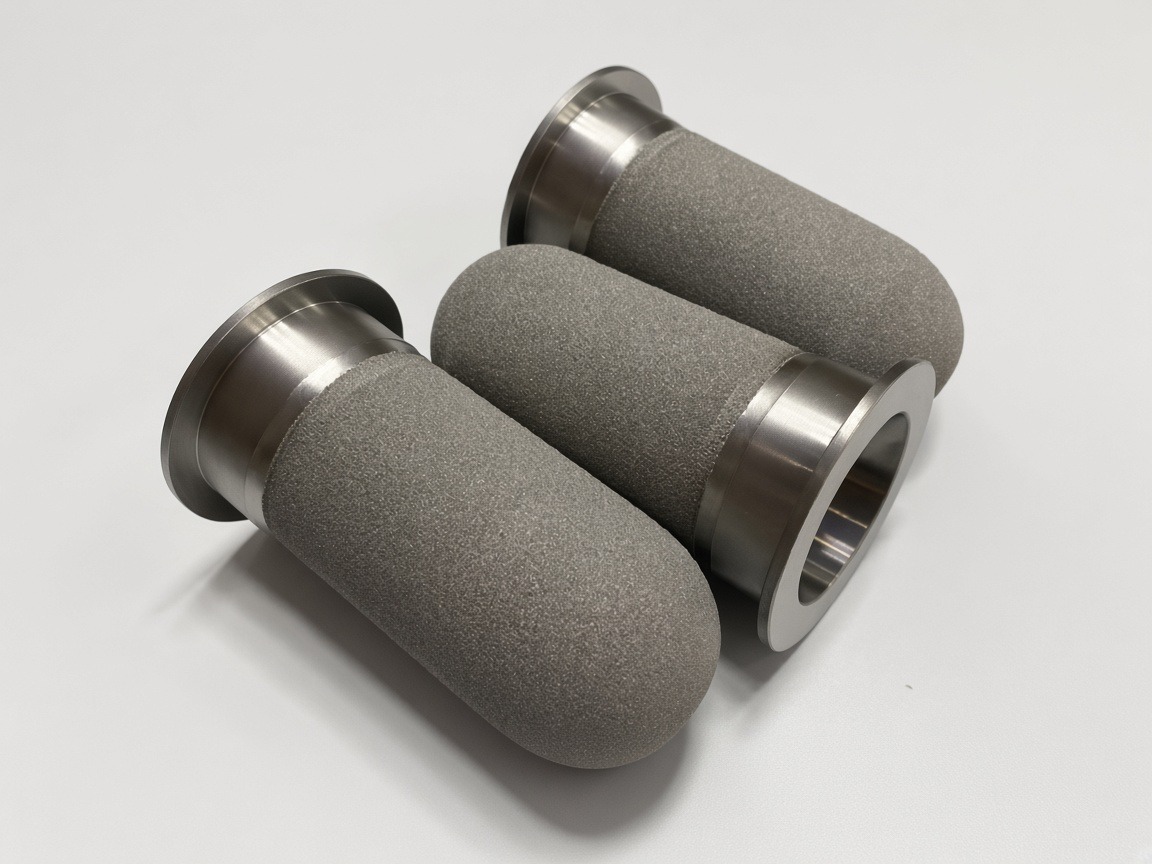
Position in the clarification housing
A porous titanium candle can be considered in a dedicated liquid-clarification housing downstream of a mixing or activated-carbon treatment step. For an outside-in design, suspension enters the vessel around the elements, filtrate crosses the porous wall and leaves through the central passage and clean-side collector. The actual drawing must confirm flow direction, seals and bypass prevention.
This is a solids-control application. The element does not remove dissolved substances simply because the body is metallic. Define the carbon or other particle population and acceptable downstream contamination before selecting a grade. During a development batch, compare recovered solids, filtrate quality and pressure-rise behavior rather than accepting a micron rating alone.
- Locate sampling points before and after the filter.
- Check that vents, drains and element joints can be cleaned as intended.
- Confirm how retained solids are removed without recontaminating the clean side.
Six parameters to confirm
Use the following as a procurement input table. No row is an unverified YUNSHENG rating. Initial sizing needs flow and viscosity at operating temperature; final acceptance needs a defined retention test and the buyer's cleanliness criteria.
On a small screen, scroll the table sideways to see every column.
| Parameter | Unit or definition | Why it matters | Required input |
|---|---|---|---|
| Particle retention | µm at stated efficiency and test method | Distinguishes removal performance from pore size | Particle distribution and acceptance limit |
| Flow and viscosity | m³/h; mPa·s at operating °C | Sets area and clean pressure loss | Normal, minimum and maximum batch conditions |
| Differential pressure | bar across the element at stated temperature | Limits loading and reverse cleaning | Clean, changeover and forward/reverse limits |
| Material identity | Specified titanium grade and certificate | Controls chemistry and traceability | Process fluid, impurities and cleaning agents |
| Geometry and seals | mm; connection and seal specification | Prevents bypass and fit errors | Housing drawing and installation envelope |
| Cleaning acceptance | Cycle and residue criteria | Determines whether reuse is appropriate | Cleaning sequence, rinsing and inspection method |
Titanium grade and retention requirements
Specify the exact titanium grade and manufacturing standard separately from the required particle retention. State the target in micrometres, the required efficiency and the challenge material or test method. The proposed porous structure, usable area and test report must demonstrate the agreed application; a micron rating alone does not define the result.
Titanium's protective film can be affected by strongly reducing or complexing chemistry; fluoride-bearing fluids deserve particular review.
Flow direction and solids discharge
A dead-end filtration layout directs the liquid through the porous wall while solids accumulate on the feed side. Confirm whether the element is designed for outside-in or inside-out flow. A reverse-cleaning cycle requires a defined discharge path, compatible valves and verified reverse differential-pressure limits; it cannot be assumed from the material alone.
Titanium grade and evidence boundaries
Grade 1 and Grade 2 titanium are distinct purchase identities. Include cleaning fluids and residues in compatibility assessment. A titanium material designation does not establish sterilizing-grade filtration, biocompatibility or medical-device suitability.
- Request the actual element's retention and integrity evidence.
- Document agreed cleaning or sterilization cycles separately from general material resistance.
- Use sample evaluation when solids loading and fouling behavior are uncertain.
Prepare a technically useful inquiry
Send the process liquid and concentration, particle source, operating flow and temperature, housing drawing and current cleaning procedure. Include photographs or a drawing of an existing element when replacing it. State what the downstream stage must be protected from and how acceptance will be measured. The resulting specification should keep retention, pressure limits, cleanliness and document requirements in separate fields.
- Identify every unknown rather than substituting a catalog value.
- Record technical deviations before confirming a replacement.
Activated-carbon clarification before final filtration
After activated-carbon treatment, the task is to retain suspended carbon or other process solids before the next filtration stage. In the illustrated outside-in candle arrangement, the suspension surrounds the element, liquid crosses the porous wall and filtrate enters the bore. The end seal and clean collector keep untreated liquid from bypassing that wall.
Deposited solids and pore fouling can increase resistance during a batch. Assess the feed and filtrate together: a visually clear sample alone does not define the retained particle fraction. Cleaning can target deposits by reverse flow or an approved offline method, but the restored flow and integrity must be assessed against the original application.
A titanium plate used for gas distribution, or a titanium-fiber transport layer used in an electrochemical stack, is a different component. Neither establishes the flow, retention or pharmaceutical-contact performance of this powder-sintered candle.
- Treat the prefilter and any validated final sterilizing stage as separate functions.
- Cleaning concentrations, time, temperature and air pressure need an element-specific procedure; they are not universal settings.
Specification and acceptance checks
Confirm the titanium candle and liquid-contact assembly together. Element-specific retention, differential-pressure and flow values are confirmed for each project; the housing schedule does not establish them. Define this prefiltration application separately from validated sterilizing filtration.
On a small screen, scroll the table sideways to see every column.
| Check | Specify | Acceptance record |
|---|---|---|
| Liquid contact | Titanium grade, process fluid and cleaning exposure | Material identity and compatibility review |
| Hydraulics | m³/h and viscosity at operating temperature | Element loss at the same liquid conditions |
| Fit and sealing | Adapter, gasket, length and drainage; mm | Element/housing drawing and bypass check |
| Reuse | Cleaning cycle and acceptable residual contamination | Post-cleaning flow, integrity and residue records |
- Set the particle challenge and filtrate acceptance method before agreeing a grade.
- Request relevant cleanliness or extractables evidence for the actual assembly.
Typical specifications
On a small screen, scroll the table sideways to see every column.
| Model | Rating at 98 %, µm | Rating at 99.9 %, µm | Air permeability (reference), m³/(m²·h·kPa) | External compressive strength (reference), MPa |
|---|---|---|---|---|
| YS-TI-001 | 1 | 5 | 6 | 2.5 |
| YS-TI-003 | 3 | 7 | 12 | 2.5 |
| YS-TI-006 | 6 | 10 | 40 | 2.0 |
| YS-TI-010 | 10 | 14 | 90 | 2.0 |
| YS-TI-020 | 20 | 32 | 200 | 1.5 |
| YS-TI-035 | 35 | 52 | 450 | 1.5 |
| YS-TI-060 | 60 | 85 | 650 | 1.5 |
Titanium Gr1 (TA1), Ti ≥ 99.5 %; porosity approx. 30–40 %. Air permeability and strength are reference values, not guaranteed minima; strength is an external-pressure (collapse) value, not a working ΔP. Finer grades down to 0.22 µm nominal on request (a nominal grade, not a sterilizing-filtration claim). Rod/cartridge OD 14, 20, 30, 35, 40, 50, 60, 70 mm; L up to 1500 mm. Max. 280 °C in air.
Reference values only; final specifications are confirmed for each custom order.
Prepare the specification for this application
Use these guides to resolve the next selection questions for this element. Each covers a separate part of the specification.
Product family: Sintered metal powder filter elements
- Sintered filter micron rating: what it does and does not tell you
Separate prefiltration retention targets from downstream sterile-filtration claims.
- Sintered filter material selection: 316L, titanium and special alloys
Check titanium grade, process chemistry and the complete porous assembly.
- How to clean sintered metal filters safely
Define cleaning conditions and inspection before returning the element to service.