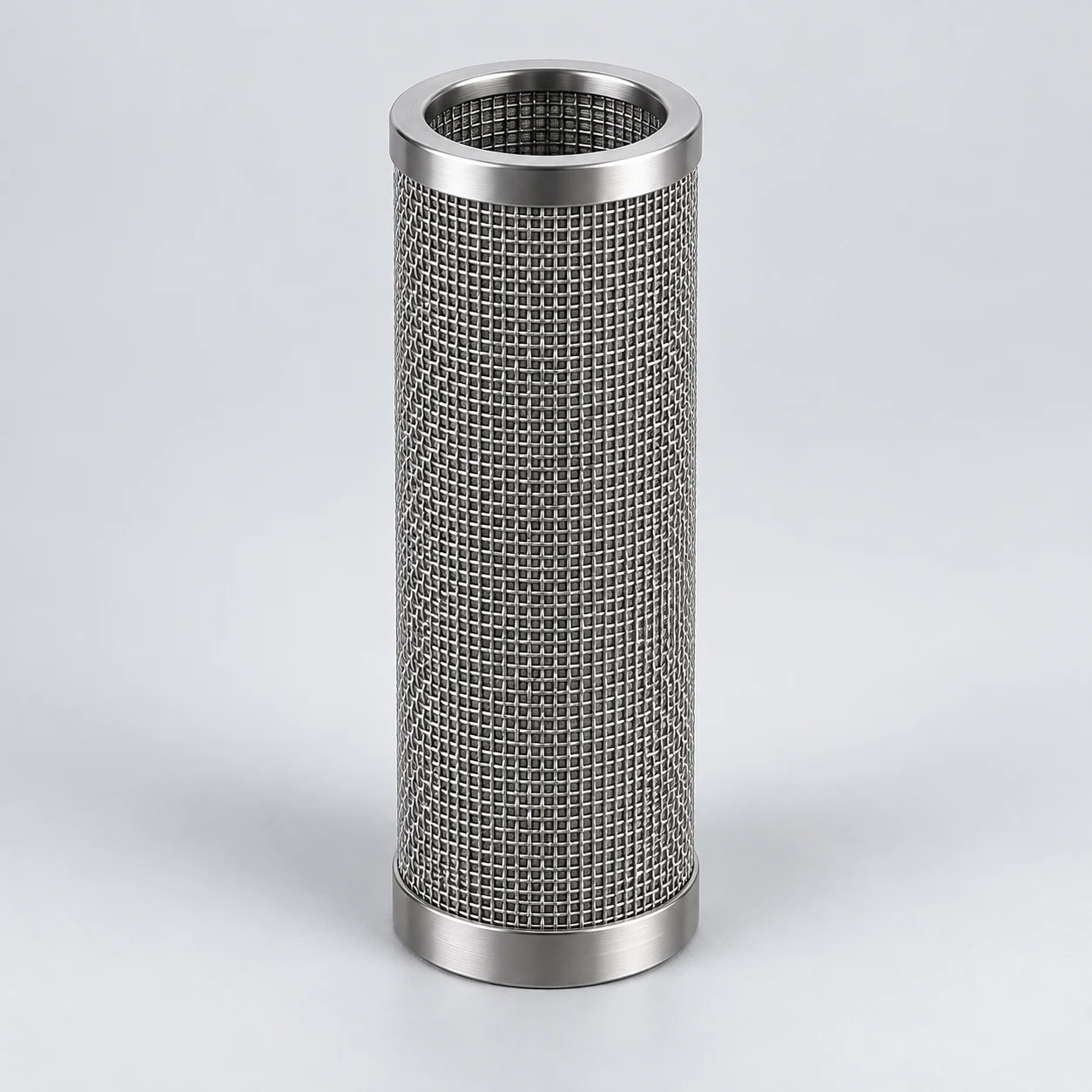
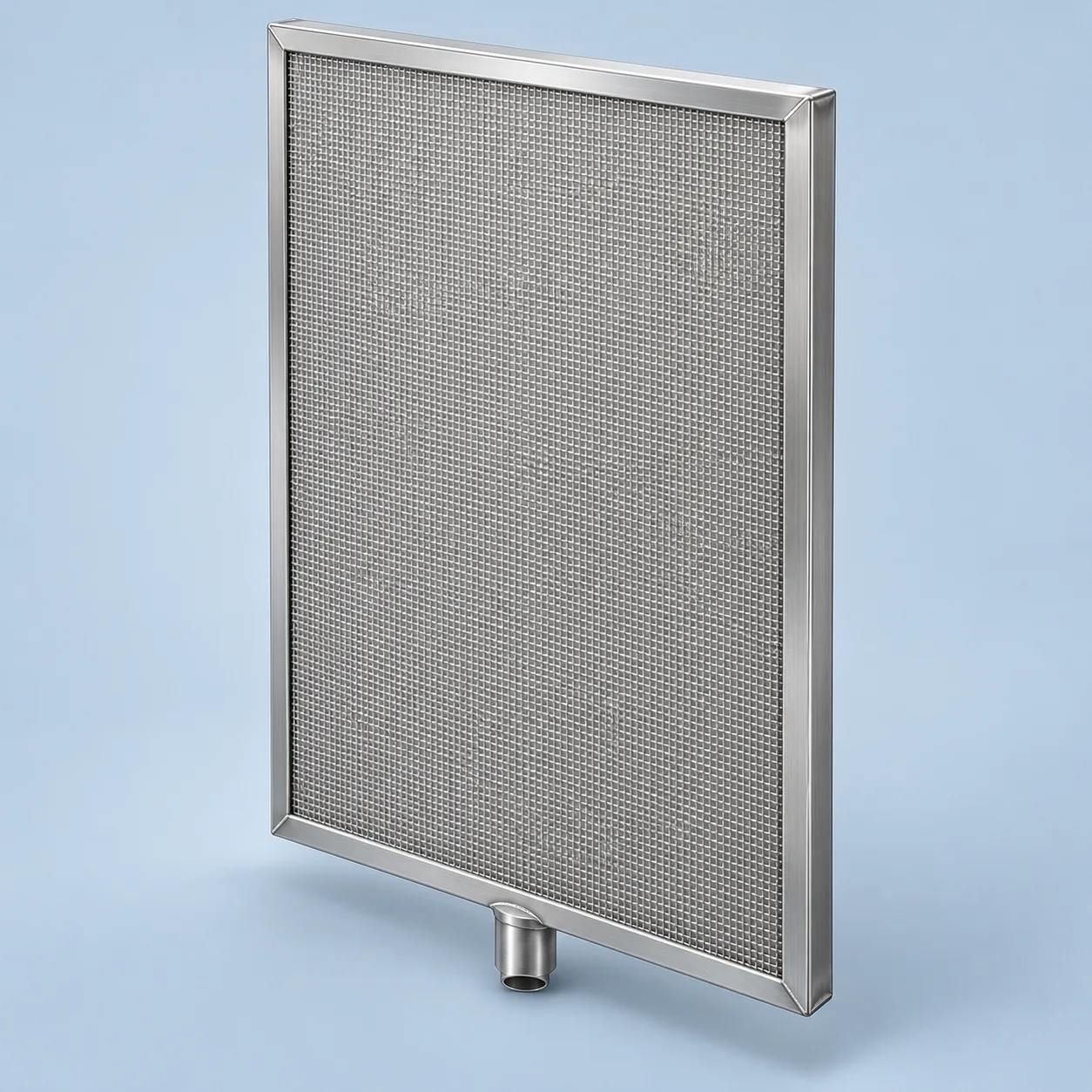
Selection guidance for a complete filter leaf. Media grade, thickness, permeability and assembly limits require separate confirmation against the equipment drawing and process conditions.
Filter leaf — mesh faces and drainage core

- Framed filtering face
A flat mesh face encloses the drainage assembly; the construction must be agreed.
- Two separating faces
Liquid can enter through either exterior face toward the drainage core.
- Liquid-filtrate drainage core
Liquid from both faces enters the internal drainage paths and flows to the lower collector connection.
- Collector connection
The leaf outlet and seal connect to the vessel filtrate manifold.
Pressure-leaf vessel — separation and drainage
One selected equipment arrangement is shown to explain position and flow. Verify actual flow, connections, seals and operating sequence against the equipment drawing.

- Vertical filter leaves
The vessel contains flat leaves, not cylindrical cartridges.
- Outer separating surfaces
Slurry reaches both faces; solids or a precoat/cake remain outside the drainage core.
- Filtrate manifold
Liquid crosses the faces, enters the internal drainage paths and leaves via the collector.
- Cake / solids discharge
Discharge and cleaning loads must be reviewed for the actual leaf construction.
The leaf is both a separation surface and a drainage assembly
A pressure-leaf vessel holds a group of leaves connected to a filtrate collector. Liquid passes from the slurry around each leaf through its outer media and internal drainage structure to the collector. The leaf-to-manifold seal separates the feed side from the filtrate; bypass at this connection can defeat the media selection.
Layered woven leaves and diffusion-bonded sintered panels are different constructions. Confirm which is required. A reference to five layers does not by itself establish sintering, the filtration grade or replacement compatibility.
Direct filtration and cake support need different evidence
The metal surface may directly retain solids or support a precoat and growing cake. Startup clarification, body feed and the terminal cycle condition affect filtrate quality. Decide whether the purchase concerns a complete framed leaf, a replaceable mesh face or a sintered-media blank.
Review drainage paths, face flatness, edge attachment and outlet sealing. An intact fine mesh cannot compensate for bypass at a damaged frame or collector joint. Cake washing, drying and discharge impose additional loads beyond normal filtration.
Media parameters to confirm
Compare media test results only when the method, fluid, area and pressure basis match. Specify the required retention separately from permeability and bubble point. The complete leaf also needs a drawing-based assessment of drainage, supports, seals and differential loads.
On a small screen, scroll the table sideways to see every column.
| Parameter | Unit or definition | Required confirmation |
|---|---|---|
| Particle retention | µm plus efficiency and challenge method | Specify the target and representative feed solids. |
| Media thickness | mm | Confirm the laminate, drainage core and finished-leaf dimensions separately. |
| Bubble point | Pa or kPa; ISO 4003 where specified | State the wetting liquid, preparation and agreed acceptance limits. |
| Air permeability | L/min/dm² or another declared basis | State test differential pressure, temperature and exposed area; ISO 4022 where specified. |
| Process pressure loss | bar or kPa at stated flow and viscosity | Separate clean-element, service and mechanical limits. |
| Finished assembly | Drawing revision and load cases | Confirm supports, collector connection, seals and forward/reverse differential loads. |
Special alloys and regeneration belong in one review
Compare 316L with more corrosion-resistant candidates only after defining the process and cleaning exposure. Options for technical discussion include 904L, duplex 2205 and nickel alloys such as C-276; availability in the required media and leaf construction needs confirmation. Verify the frame, drainage core, collector connection and weld materials as well as the outer filter layer.
Evaluate vibration, backwash or chemical cleaning against the actual framed construction. Do not prescribe abrasive scraping or aggressive chemistry before a procedure is approved for the complete assembly.
What a useful leaf-filter inquiry contains
Provide the vessel arrangement, controlled leaf drawing, connection detail, slurry and precoat description, flow/viscosity, cycle pressure record and discharge method. Request a clear distinction between confirmed compliance, proposed deviation and missing evidence for each item.
- Define filtrate clarity during startup and the stable part of the cycle.
- Request dimensional and leak/bypass checks for the complete leaf.
- Agree a clean baseline and inspection after the proposed discharge/cleaning sequence.
Specification and acceptance checks
Identify whether the purchase is a complete framed leaf, a replaceable mesh face or a sintered panel. Accept the drainage core, edge attachment and collector seal as part of the assembly; media grade alone cannot verify the leaf.
On a small screen, scroll the table sideways to see every column.
| Check | Specify | Acceptance record |
|---|---|---|
| Supply boundary | Frame, face, core and outlet components | Itemised drawing and material schedule |
| Cycle | Startup, precoat if used, cake washing and discharge | Filtrate criteria for each agreed stage |
| Media test | Retention and permeability with declared method | Test fluid, area and differential pressure |
| Assembly acceptance | Flatness, outlet seal and permitted loads | Dimensional, bypass and post-cleaning checks |
- Review collector-joint leakage separately from media retention.
- Confirm discharge and cleaning loads for the actual framed construction.
Prepare the specification for this application
Use these guides to resolve the next selection questions for this element. Each covers a separate part of the specification.
Product family: Sintered wire mesh filter elements
- Sintered filter micron rating: what it does and does not tell you
Separate mesh retention from startup clarification and precoat or cake performance.
- Sintered metal filter pressure drop and flow area
Specify clean-leaf resistance separately from the growing cake and terminal cycle.
- How to clean sintered metal filters safely
Check cake discharge and cleaning against the frame, drainage core and collector seal.